


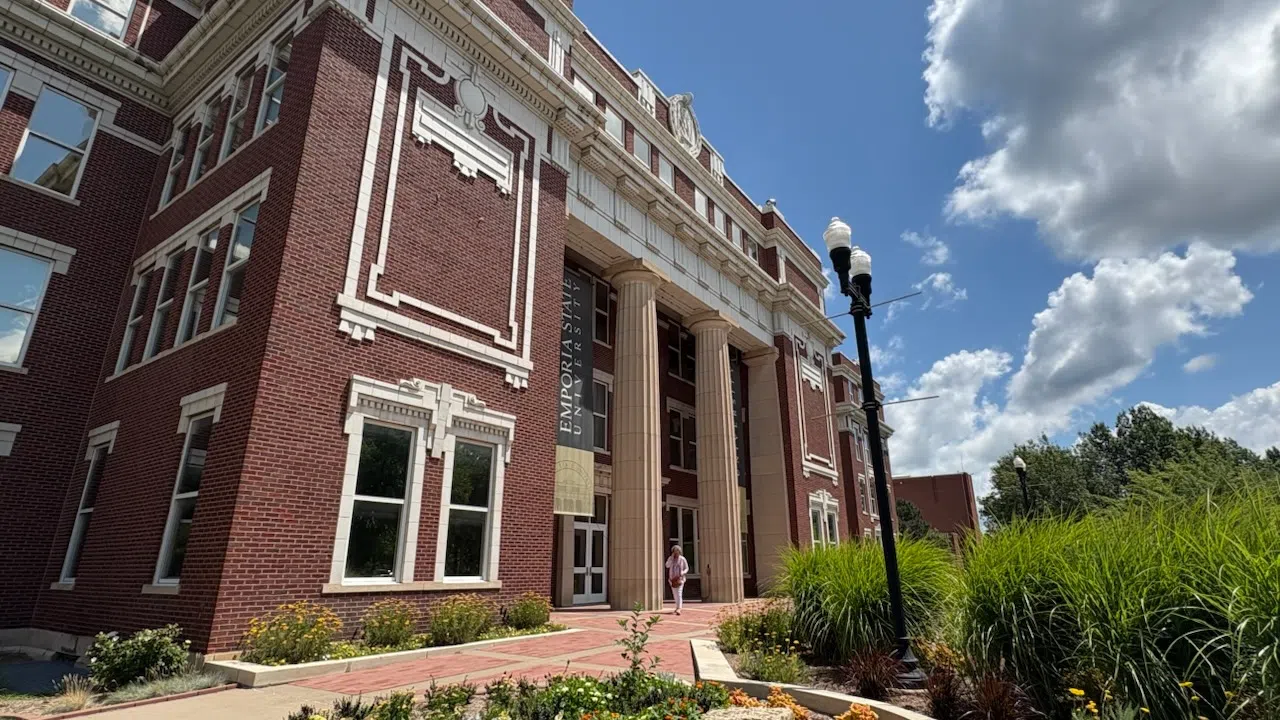
Emporia State University is proclaiming a Year of Celebration.
The university says it is now on a “positive path forward” after lengthy trends of declining enrollment, increasing popularity of distance or online education and deepening deficits led to fewer on-campus students, reduced on-campus activities, decreased tuition revenue and the related decision by the Kansas Board of Regents to hire Ken Hush, first as interim president in 2021 and as permanent president the following year. Executive Vice President for Operations Kelly Heine tells KVOE News this has been a period of positive transformation on campus.
At the time, former Board of Regents chair Cheryl Harrison-Lee said the Hush hire was part of an effort to “re-engineer education” and reflected the post-COVID realization “we are not able to do business like we’ve always done it.”
In fact, Heine says ESU was on track to not be fiscally viable beyond June 30, 2024, if the university’s financial direction didn’t change.
ESU was able to eliminate a $19 million budget deficit, in part due to over $40 million in state support over the last three years. It has also noted significant investments in a lengthy range of areas, including but not limited to:
*$11 million in student activities, majors, recruiting and staff
*A pair of $5 million gifts for the Nursing & Student Wellness Center now under construction. The facility is also the first academic building on campus since 1979, has not required state money and will be debt-free once built
*Unprecedented support from the ESU Foundation, including $10 million in student scholarships, $3 million for additional unrestricted funds and $1 million per year in funds available due to increased spending rates
Heine says the support and increased presence of different partners has been immense. She also says alums have stepped up to help.
ESU is also reporting the elimination of over $160 million in inefficiencies and waste, a 20-percent decrease in deferred maintenance costs, a 15-percent improvement in optimizing campus space and $5 million in additional employee compensation. As part of its early post-COVID restructuring, the university also terminated about 30 professors, many of whom were tenured or tenure-track educators.
For students, ESU has kept tuition and fees flat for two straight years, including a cut in student fees for the fall 2024 semester, while reinstating student jobs and graduate assistant programs and increasing the student minimum wage. In addition to expanding in-state tuition across the lower 48 states, ESU has also started classes for area high school students at $21 per credit hour. Enhancements in scholarships and other opportunities are campus-wide after Emporia State highlighted several key “strike zone” programs as its focal points shortly after Hush came on board — a point not lost on Heine.
ESU says the work over the last three years, including these initiatives as well as re-accreditation through the Higher Learning Commission, a new Opportunity College and University designation by the Carnegie Foundation and the opening of the Cybersecurity Research & Outreach Center, have led to increases in community impact through different activities, as well as a regional economic impact of $225 million per year.
ESU plans to celebrate its Year of Celebration during Homecoming activities Oct. 31 through Nov. 2. Details will be announced later.