

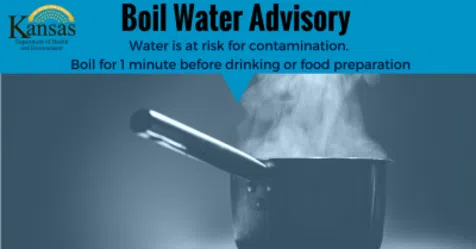
Residents in southwest Lyon County remain in a boil water advisory until further notice as the source point of the alert remains hidden.
Lyon County Rural Water District 3 and the Kansas Department of Health and Environment issued the alert late Thursday after a water main break. Office Manager Julie Langley says staff and Kansas Rural Water Association representatives searched an area near Road J between Roads 30 and 60 for much of Thursday without success. A thermal imaging drone has been in the air as part of the effort Friday morning.
Langley says the advisory affects around 50 customers in areas fed by the district’s south standpipe on Road 50 near Kansas Highway 99. Areas fed by the district’s west standpipe near Olpe City Lake, including Olpe, are not impacted.
The south standpipe isn’t completely drained, but Langley says the usable water is unavailable. The district plans to install several valves as a way to pinpoint the leak area.
7:15 pm Thursday: Lyon County RWD 3 in boil water advisory
Lyon County Rural Water District 3 says it and Kansas Department of Health and Environment issued the advisory late Thursday after a water line break caused a loss of pressure in what RWD 3 calls a two-block portion of the system. Office Manager Julia Langley says crews have been searching a three-mile line of pipe in fields near Road J between Roads 30 and 60 as part of an effort to find the source point. Representatives of the Kansas Rural Water Association are also part of the effort. A thermal imaging drone has been in the air for much of Friday morning.
Loss of pressure is a health concern because it may lead to a loss of chlorine residuals and a resulting risk of bacterial contamination.
Olpe is not included in the advisory. Langley says this affects the south part of the system.
Once the situation is resolved, RWD 3 will submit at least one set of water samples to KDHE for testing and review. KDHE will lift the advisory once all concerns about water safety are resolved.
In the meantime, RWD 3 says customers should follow several precautions:
*Flush any water lines that appear dirty by letting water run until it clears
*Boil water for 60 seconds before drinking or food preparation. Use bottled water if you decide not to boil water
*Dispose of all ice cubes and do not use ice from a household automatic icemaker
*Disinfect dishes and other “food contact surfaces” by immersing them in a solution of one teaspoon of unscented bleach per gallon of clean tap water
*Bathing water generally does not have to be boiled, but children need to be supervised so they don’t drink the water. People with cuts or severe rashes should consult their doctors
Consumers with questions can call RWD 3 at 620-654-3561 or KDHE at 785-296-5514. Restaurants or other food establishments with questions can email kda.fsl@ks.gov or call 785-564-6767.