

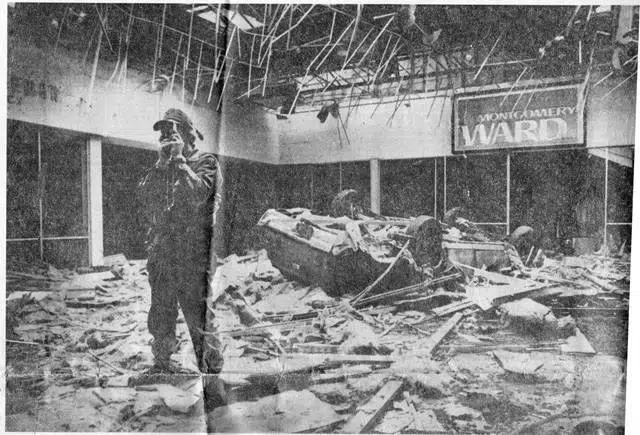
If Emporia’s 1974 tornado had happened today, the destruction may not have been avoidable but the loss of life might have been.
The tornado essentially formed without warning on Emporia’s west edge, smashing through Flinthills Mall and Lincoln Village at the start of a nearly 40-mile path. It killed six people and injured over 200.
National Weather Service meteorologist Chad Omitt says technological advances have made it easier to spot potential conditions days in advance. Back in the 1970s, radar technology — and really the knowledge of atmospheric conditions leading to tornadoes — were both extremely limited.
On the day of the tornado, Omitt says meteorologists were looking for the classic hook echo, where there is a notable curl normally near the southern end of the storm. It wasn’t there, and Omitt says the tornado could have been rain-wrapped, making radar detection all but impossible in that day and age.
Omitt says technology has made it easier to see rapid changes on the day of a potential tornado event, but it has also made it easier to see conditions possibly coming together days in advance — and with nearly 40 tornadoes total in Kansas, Missouri and Oklahoma on June 8, 1974, Omitt says the Weather Service and media outlets would have been alerting people about the potential bad weather well ahead of the outbreak.
Kansas had five tornadoes that day with the Emporia tornado by far the worst of the lot.
The 2021 season has been abnormally quiet, as was the case last year. However, Omitt says people still need to pay attention to the weather forecasts. May and June are the peak tornado months in Kansas.
The 1974 F-4 tornado that hit Emporia is overshadowed by the 1966 F-5 that hit Topeka on the same date. It also overshadows an F-2 tornado that struck far west Emporia on June 7, 1990. The 1990 twister injured close to 20 people on a 10-mile path out of town.
Photo Gallery
Photos and documents from National Weather Service.