


Emporia residents will notice a slight increase in their monthly water bills starting next year following action by Emporia City Commissioners during their regular action meeting Wednesday.
The specific action taken by commissioners was a 4-1 approval of a new Equivalent Residential Unit (ERU) structure, a fee that will be added to residents’ water bills to create a dedicated revenue stream for stormwater improvements across the community. During an interview with KVOE News on Thursday, Deputy City Manager Mark Detter noted that previously, there has not been such a revenue stream with the city traditionally using sales and property tax dollars to cover those costs.
He noted that while nobody likes additional fees, the ERU will mean less impact on property taxes.
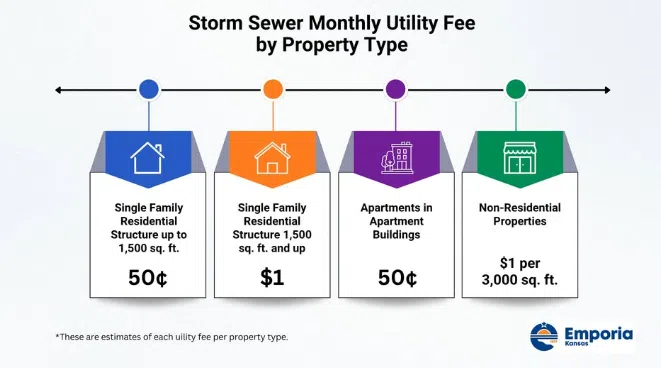
The new fee will result in an additional 50-cent charge for average homeowners beginning in January. As for other properties, the ERU would be based on “impervious area,” areas that contribute to stormwater runoff. We have a breakdown of the formula online at KVOE.com.
Back in May, when the fee was first discussed, City Commissioner Susan Brinkman expressed several concerns with the plan, namely that it would affect “Emporians into future generations.”
Brinkman also stated she was not in favor of USD 253 Emporia being affected by the fee, noting it would result in nearly $10,000 per year in additional costs.
With that in mind, she told KVOE News back in May she would not vote for the fee if the district was included and she stayed true to her word, serving as the lone no vote on the matter Wednesday. Brinkman did offer an alternative suggestion for funding storm water improvements, one that would be a collaborative effort between the city, Lyon County, USD 253 and the Emporia Recreation Commission.
During the same meeting in May that the ERU was first proposed, Detter also presented a new task force involving all four of the aforementioned entities which would be focused on finding ways to reduce the city and county’s overall mill levy rate, possibly by as much as 20 mills.
Rather than using the ERU fee, Brinkman suggested the city instead look to possibly reduce the levy by 15 mills and use the remaining 5 to fund stormwater improvements as an example. Detter stated he understands that idea, however, it would still be utilizing tax dollars and in his opinion, it may not be the fairest option, noting that not all entities have to pay said taxes.
Given that nearly all businesses and properties have to pay a water bill, Detter says he believes using the ERU for that purpose is the fair thing to do.
That said, Detter noted that nearly everyone pays a water bill, meaning everyone is contributing their fair share.
It is worth noting that before voting on the ERU on Wednesday, commissioners did note that it can be altered in the future if the commission deems it necessary. Again, the ERU will not begin appearing on customers’ water bills until January of next year.