


All organizations, businesses, and companies have standards for safety and security, but at Wolf Creek Nuclear Operating Plant, safety is more than a standard; it is a core value of the company.
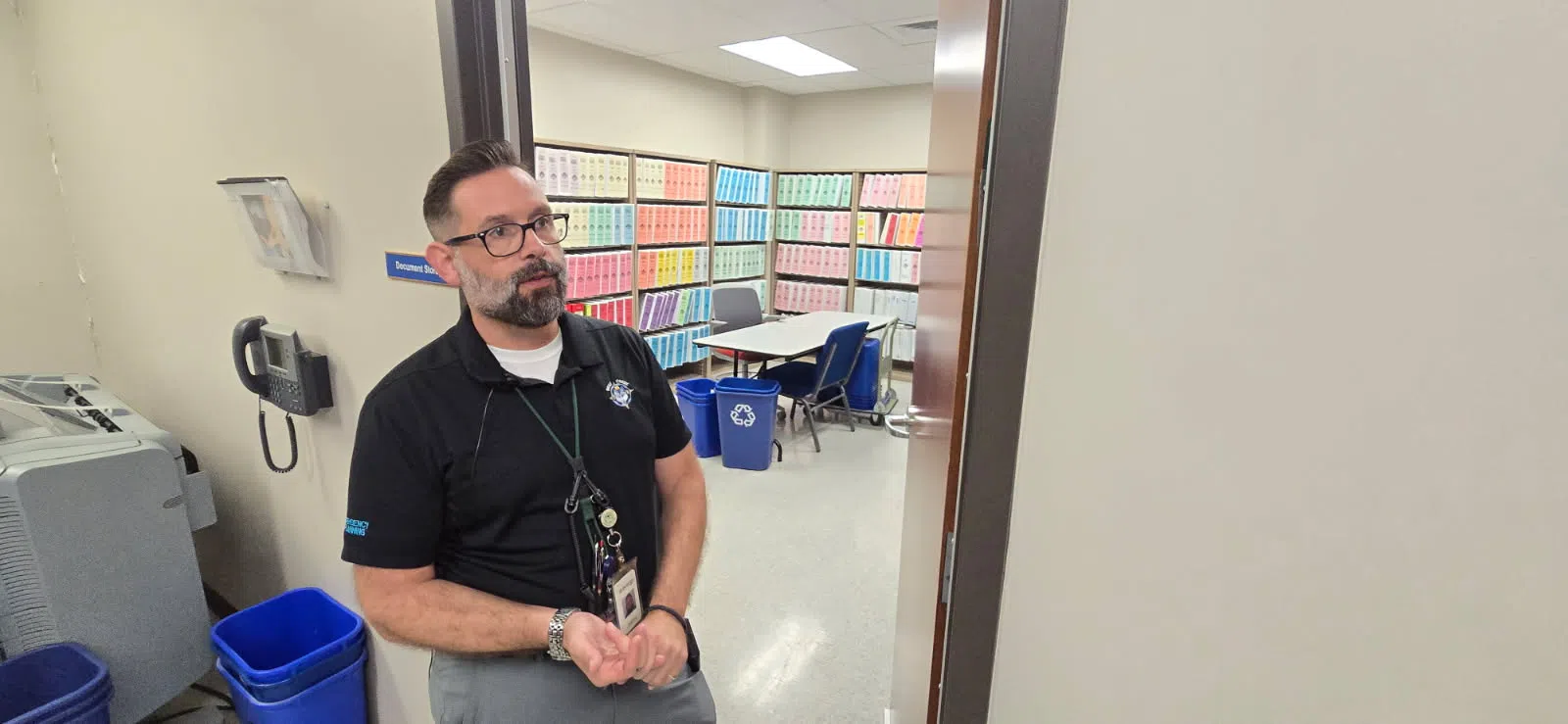
Thursday, local media were given an in-depth look at the company’s dedication to that value through the annual media day at Wolf Creek’s Emergency Operations Facility located just past Lebo at 2718 Lynx Place. During the event, KVOE News and others were given a tour of the facility and an in-depth explanation as to its role in emergency response and management, not only within the Wolf Creek plant, but the community in general.
According to Wolf Creek Emergency Planning Manager Joshua Bousum, these opportunities to communicate with local media partners are a vital tool to helping explain a vital process.
Bousum tells KVOE News that when it comes to emergencies at nuclear operating plants, the Nuclear Regulatory Commission (NRC) has four classifications:
*NUE (Notification of Unusual Event): The least serious of the four classifications. Refers to a minor problem out of the ordinary with no likely risk of radioactive material being released or leaked.
*Alert: An event has occurred that could reduce the level of safety at the plant, but back-up systems are available. Emergency agencies are notified and asked to stay in touch, but no action by the public is necessary.
*Site Area Emergency: An event where it is declared that there is a problem with plant safety systems and a release of small amounts of radioactivity is possible into the air or water around the plant.
*General Emergency: Most severe classification. Declared when an event at the plant causes a loss of several safety systems that could lead to radioactive material being released outside of the plant. State and County officials may take actions to protect the public’s health and safety.
While the emergency response protocols are enacted specifically for a situation that develops within the plant itself, the physical response is not limited just to Wolf Creek staff. We’ve all heard the expression “It takes a village” for a variety of scenarios, but when it comes to this specific type of situation, Bousum says it “Takes a state” to respond properly, and that is exactly what happens.
In the event of a major incident, representatives from both the state and county levels will respond to the site to assist in a variety of roles. At the state level, the Kansas Department of Health and Environment plays a role in recommending next steps, according to KDHE Radiation Control Section Director Jason Meinholdt.
Putting those recommendations into action happens at the county level, according to Coffey County Emergency Management Director Amanda Presley. Presley tells KVOE News that when it comes to putting those recommendations into action, there are many other factors the county has to consider aside from just the ongoing situation before making any decisions.
From the state side, once an emergency has concluded and the all clear is given, Mark Ungerer of KDHE says their work is not over; in fact, it is just getting started.
Bousum says when it comes to emergency scenarios at Wolf Creek, there has only been a small handful of incidents in the past several years, none of which were near the top of the NRC classification list. That said, while emergencies do not occur with great frequency, Bousum says Wolf Creek, alongside their county and state partners, performs frequent drills and exercises to ensure everyone is prepared for any scenario in compliance with requirements from the NRC.
Presley says, “You would be amazed” by some of the scenarios they come up with.
Meinhioldt says this high level of preparation and planning by Wolf Creek has made it an invaluable asset to the state of Kansas beyond just providing nuclear power.
Wolf Creek has been in operation since 1985 and generates approximately 1,250 megawatts of electricity capable of powering more than 800,000 homes. Now in its 40th year of operation, Wolf Creek had its license renewed for another 20 years of operation, keeping the plant going through at least 2045.
The plant, located in Burlington, employs roughly 700 full-time staffers with more than 200 supplemental staff. Thursday’s media day comes with Wolf Creek quickly approaching its next scheduled refueling outage next month. The outages occur every 18 months and in addition to the refuel, allow time for necessary maintenance and repair work.