


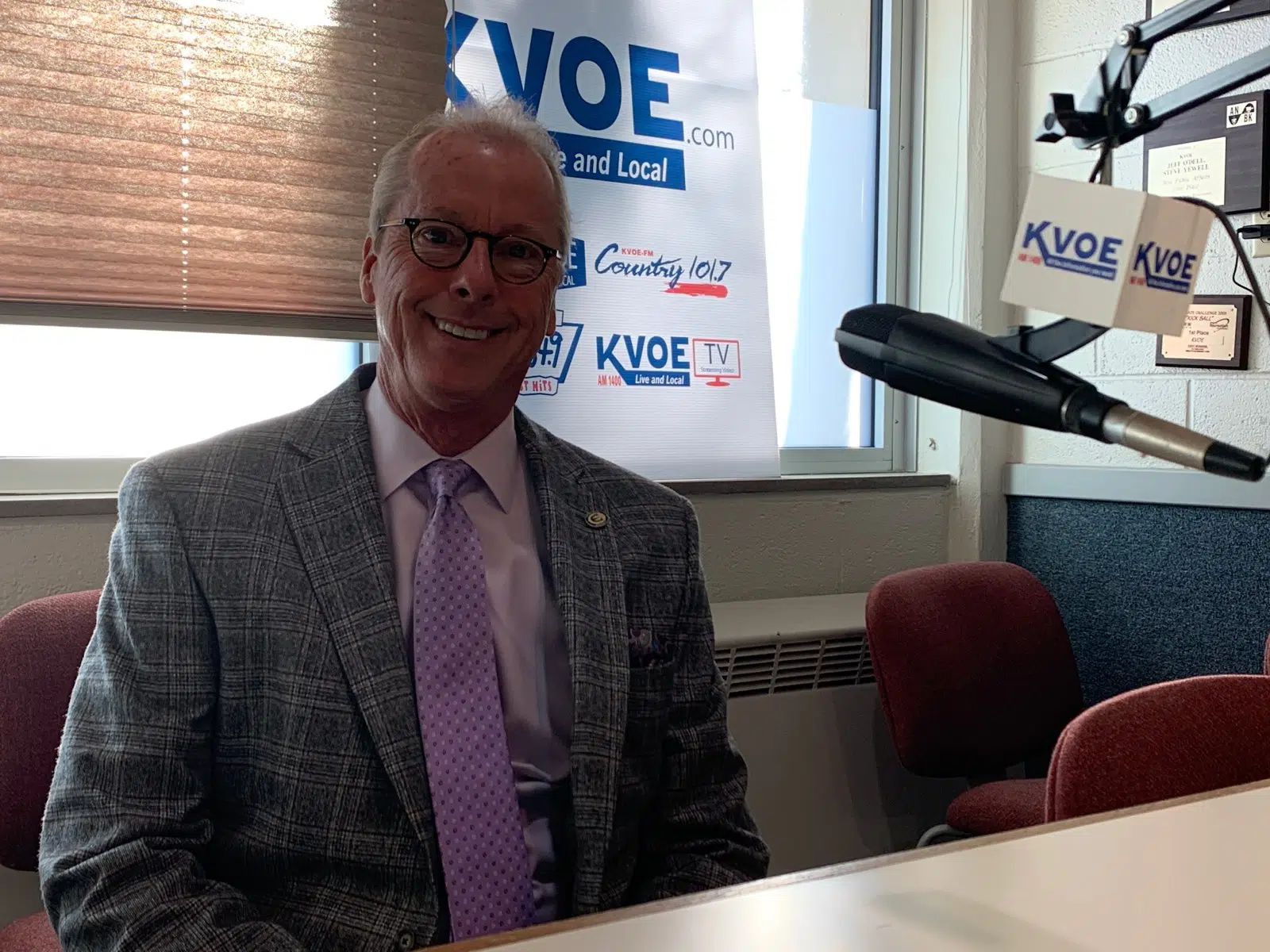
Nearing a month into his retirement, former Emporia State University President Ken Hush says the university is in good shape for its next leader.
Hush joined KVOE for an interview airing Thursday on the ESU Buzz segment. A star on Emporia State’s tennis team while he was a student, Hush says he was focused on the opening of the Kossover Tennis Center in late 2021 — shortly after former president Allison Garrett announced her resignation — when then-Kansas Regent Cheryl Harrison Lee pulled him aside to start discussing the university “from a business analytics” viewpoint.
Hush admittedly dragged his feet initially, reminding the Regents of his business background as opposed to a traditional education base. When he agreed to the role, the Regents asked him to dive into ESU’s state of affairs and report back. Hush and the leadership team began interviewing people on campus before reporting and offering solutions to the Regents before he accepted the permanent role. Concerns started with the organization chart, which was “heavy heavy” in a lot of areas.
And then came the financial discoveries, largely rooted in previous budget cuts.
Hush repeatedly said his processes were all about “students, students, students” — but while the fall 2025 semester was glowing just about across the board, the path to that point was rocky — especially early in his tenure. The initial end result: merging some programs, ending others and separating from over 30 professors as part of the Regents’ COVID-19-era Framework for Workforce Management — a set of decisions that still riles up residents. But Hush says it was the path ESU had to take because the financial picture was a lot more troublesome than the university let on to the public. Hush says cash on hand was getting burned through quickly, bringing ESU close to a shutdown.
ESU had to reinvest in student programs, both with majors and recruiting/retention, while setting the stage for eliminating millions of dollars in deferred maintenance or other operations costs.
Hush says a lot of ventures went into place simultaneously or in an overlapping fashion, all with a definite time frame in mind for measuring success.
Financial turnarounds are typically much slower in higher education versus the business world, and even with new donors and additional funding from the state, the ESU turnaround has taken three to four years as opposed to a year or less in a business setting. Regardless, given where ESU was in 2021 and 2022, Hush says the turnaround in new students, new buildings, new programs and new scholarship opportunities — all while keeping tuition, room and board and other fees flat — has been good to experience.
Hush officially retired Dec. 17.
He admits it has been difficult at times to process the fact he’s no longer leading his alma mater.
Come early March, Matthew Baker will officially take over as president after nearly 30 straight years at Northwest Missouri State University, meaning Taylor Kriley will shift from interim president to her existing role as the university’s executive vice president of enrollment management and student success. Hush says his brief conversation with Baker was not related to ESU operations, and he says the Baker family will be good for the university. He also says Baker is coming into a good position.
Hush also says he will return to consulting — which he had been doing before the Regents called for his advice. He says Emporia State is about three to four yeas ahead of other universities nationwide that are facing similar financial hurdles.
Hush also plans to stay in Emporia as he resumes his consulting career. He says is is also looking at other ways to help others as he changes careers.