

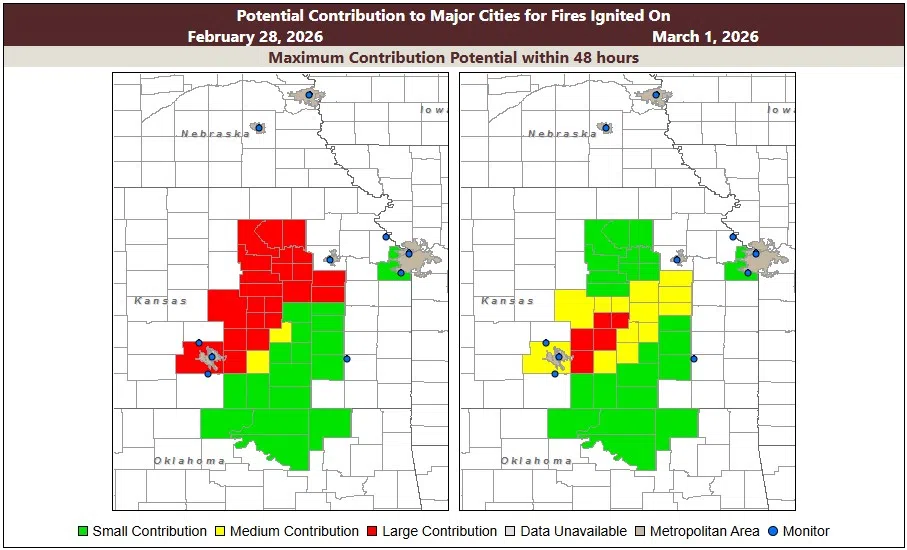
On Sunday, the Kansas Department of Health and Environment activates the Kansas smoke modeling tool.
The computer model, available at the Flint Hills Smoke Management Plan website at ksfire.org, lets landowners predict possible smoke and air quality impacts downwind from fire activity. Air quality is a consistent concern in areas north east of the Flint Hills, occasionally as far north as Minnesota or Wisconsin and as far east as Tennessee, and the particulate matter released by prescribed burns can cause a list of health issues including burning eyes, runny noses, coughing and illnesses like bronchitis.
KDHE says fire is an important management tool because it helps to control invasive plant species like Eastern Red Cedar while preserving the tallgrass prairie ecosystem, developing better forage options for cattle and reducing the risk for unplanned fires.
This is the first part of the state’s annual Flint Hills Smoke Management Plan. Burn restrictions will take place again in April, limiting fire activity to controlled pasture burns, ceremonial fires and grilling.